Miami Spice is easy to understand as a diner. It is harder to understand as an operator.
For a diner, the proposition is straightforward.
Miami Spice Restaurant Months runs through August and September and offers specially priced three-course meals across Greater Miami and Miami Beach. In 2026, the official program includes $40 brunch and lunch menus, $50 and $65 dinner menus, plus a new Reserve tier starting at $95.
The Greater Miami Convention & Visitors Bureau presents the program as a way to explore Miami's dining scene at a lower barrier to entry.
That part is clear.
What became less clear to me after actually using the program and talking with restaurant managers was what success looks like from the restaurant's side of the table.
During recent Miami field visits, I asked two participating restaurant managers two questions that I assumed would be relatively easy to answer.
First:
Do people who first discover your restaurant through Miami Spice come back after the promotion?
One manager believed some did, but was not certain.
The other did not believe the program was generating meaningful repeat business.
Then I asked a second question:
What does it actually take in management time, menu development, food sourcing, training and operational effort to create and deliver the Miami Spice menu?
Neither manager could quantify the time or cost involved.
That does not mean either restaurant is poorly managed.
It does not mean Miami Spice fails.
And two conversations are absolutely not a representative study of Miami restaurants.
But they exposed a question worth asking more broadly:
If a promotion successfully brings new people through the door, how many participating restaurants know what happens after those people leave?
Miami Spice was created to solve a business problem
This question becomes more interesting when you look at why Miami Spice exists in the first place.
In an August 2026 tourism-industry update, the GMCVB described Miami Spice as beginning in 2002 as an economic-development initiative designed to support the restaurant community during quieter summer months.
Twenty-five years later, the program has become one of Miami's signature culinary traditions.
The official goal has also broadened.
GMCVB material says the program exists to inspire residents and visitors to explore restaurants, neighborhoods and the broader Miami dining scene.
That means Miami Spice is doing several jobs at once.
For the destination, it supports culinary tourism and economic activity during a historically softer period.
For restaurants, it can create incremental traffic and introduce diners to places they may not otherwise try.
For locals, it lowers the financial barrier to discovering a restaurant that may normally feel like a special-occasion choice.
For visitors, it can become another reason to explore Miami through food.
Those are all legitimate objectives.
They are not, however, the same objective.
So who is Miami Spice actually for?
The most accurate answer appears to be:
the restaurant, the local diner and the visitor — but each needs a different definition of success.
That distinction matters.
If a Miami resident tries an independent restaurant for the first time through a $40 or $65 prix-fixe menu, a reasonable long-term question is whether that person returns after Miami Spice ends.
A restaurant could potentially examine a 30-, 60- or 90-day return window.
But a tourist is different.
A visitor from Chicago, Toronto or London may have an outstanding dinner and still have no realistic opportunity to return within 90 days.
For that guest, success may look more like:
- →choosing the restaurant over another option during the trip
- →purchasing cocktails, wine or additional items beyond the prix-fixe menu
- →leaving a useful review
- →recommending the restaurant to another traveler
- →following the restaurant for a future Miami trip
- →returning the next time they visit the destination
That creates a basic measurement problem.
A restaurant cannot intelligently judge repeat business without first knowing whether the Miami Spice diner was a local, a visitor or an existing customer.
Are tourists even aware of Miami Spice?
This is another question I think deserves more attention.
The official program clearly intends to reach visitors as well as residents. The GMCVB itself is a destination marketing organization whose mission includes attracting leisure, business, meeting and convention visitors to Greater Miami and Miami Beach.
Its current Miami Spice page even frames Miami dining as part of a great getaway.
So visitors are unquestionably part of the intended audience.
What we do not have is public evidence showing what percentage of visitors arriving in Miami during August and September know Miami Spice exists before they arrive, discover it during the trip or actually use it.
That should not be guessed.
A local may hear about Miami Spice year after year through local media, friends, social feeds and established habits.
A first-time tourist may need to encounter it through an entirely different path:
- →hotel concierge or front-desk recommendations
- →destination websites
- →Google searches
- →travel planning articles
- →restaurant social media
- →paid destination promotion
- →a reservation platform
- →a friend who already knows the program
That makes the visitor question commercially important.
If a restaurant believes tourists are an important Miami Spice audience, it should know how those tourists are discovering the offer.
Otherwise the restaurant may be participating in a destination-wide promotion without understanding which part of the destination audience it actually reaches.
My Little Havana dinner made the question tangible
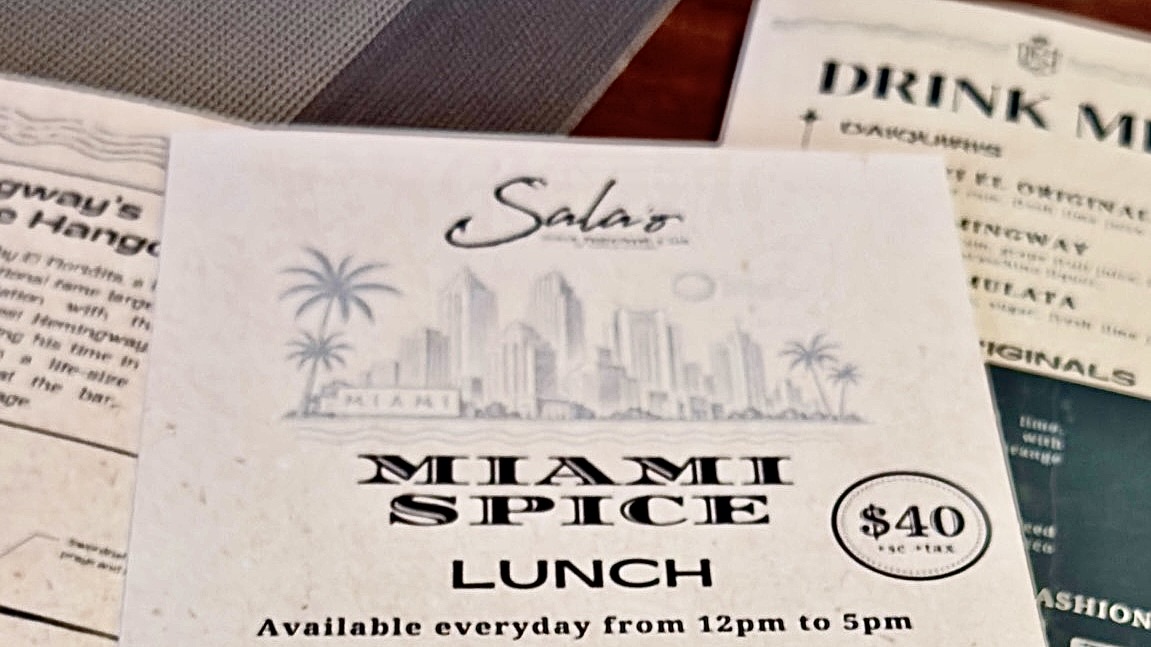
During a recent dinner visit to Sala'o Cuban Restaurant & Bar in Little Havana, I photographed the restaurant's $40 Miami Spice lunch menu at my table. The image shows the lunch offering even though my visit took place at dinner, which made the broader operator question more interesting to me: what exactly is the restaurant trying to achieve through Miami Spice, and how is that success being measured?
The menu offered a choice of appetizer, entrée, dessert, cocktail and side.
As a diner, that is attractive because it reduces uncertainty. The price is clear. The structure is clear. The experience gives someone an approachable way to sample the restaurant.
But sitting there, I kept thinking about the restaurant's side of that sheet of paper.
How long did it take to choose those dishes?
Were the selections based primarily on food cost, operational ease, guest appeal, signature items or some combination of all four?
Did the kitchen need different prep levels or purchasing quantities during Spice?
Was staff trained to explain why a first-time guest should return for the regular menu?
Does the restaurant know whether the guest sitting at that table had ever been there before?
Does it know whether that guest lives 10 miles away or 1,000 miles away?
Those questions are not visible on the menu.
But they determine what the promotion may actually be worth.
The promotional price is not the full cost of participation
Restaurant promotions are often discussed through menu price and food cost.
That is necessary, but incomplete.
A serious operator might also want to understand:
- →management time spent selecting the menu
- →chef and kitchen-development time
- →ingredient sourcing and purchasing changes
- →recipe costing
- →prep complexity
- →staff training
- →menu design and printing
- →reservation and table-turn patterns
- →service-time differences
- →beverage attachment
- →complimentary or promotional extras
- →marketing time
- →reservation-platform costs where applicable
- →whether the Miami Spice menu displaces higher-margin regular-menu orders
Not every restaurant needs an accounting exercise worthy of NASA.
But if nobody can estimate the investment required to participate, it becomes difficult to know whether the restaurant earned a useful return from the promotion.
Miami Spice may have two scoreboards
The first scoreboard is visible immediately:
How many Miami Spice covers did we serve?
That matters, particularly if the historic purpose of the program is to support restaurants during quieter summer months.
But there is a second scoreboard that is potentially more valuable:
What happened because those people came through the door?
For a first-time local diner:
Miami Spice visit → second visit → regular-menu purchase → referral → long-term customer.
For a tourist:
Miami Spice discovery → dining experience → incremental spend → review or recommendation → future-trip consideration.
For an existing customer:
Miami Spice may simply create another visit during a period when that guest might otherwise have stayed home.
All three can be valuable.
But they should not be counted as though they are the same customer-acquisition outcome.
A simple Miami Spice operator scorecard
A restaurant does not need surveillance-level customer tracking to learn from the program.
It could begin with a handful of practical measures, respecting privacy and consent requirements:
1. First-time or returning?
Train the team to ask naturally whether the guest has visited before, or include an optional question during reservation or post-visit feedback.
2. Local or visitor?
A simple city or ZIP-code field, where appropriate and voluntarily provided, can dramatically change how repeat behavior should be interpreted.
3. Promotional check versus total check
Measure the actual average check after beverages, supplements and legitimate add-ons rather than looking only at the fixed menu price.
4. Contribution, not just revenue
Understand the food, labor and operating implications of the promotional menu well enough to know whether increased volume is commercially useful.
5. Return behavior
For identifiable local guests who have voluntarily entered the restaurant's reservation, loyalty or email ecosystem, look at repeat visitation after the promotion.
6. Visitor advocacy
For travelers, reviews, referrals, social sharing and future-trip engagement may be more realistic indicators than a 30-day return visit.
7. What did guests actually like?
Which Spice dishes generated questions about the regular menu? Which items were mentioned in reviews? Which experiences created conversation with staff?
That information can make the promotion a learning tool rather than merely a seasonal discount.
The menu should introduce the real restaurant
There is another risk with any prix-fixe promotion.
If the promotional experience is substantially weaker than the regular one, a new diner may form the wrong impression of the property.
If it is so operationally complex that staff struggle to deliver it, the restaurant may create volume while weakening the experience.
And if the Spice menu contains none of what makes the restaurant memorable, the diner may enjoy a bargain without ever understanding why the regular restaurant deserves another visit.
That is why the smartest question may not be:
How cheaply can we build a three-course menu?
It may be:
What can we put on this menu that accurately introduces a first-time guest to who we are?
The promotion should create trial without making the guest feel like a discounted version of a regular customer.
The customer and the business do not have to be on opposite sides
Asking who Miami Spice is “really for” can sound like there must be one winner.
I do not think that is the useful conclusion.
A well-designed program can create value for the diner, the restaurant and the destination simultaneously.
The diner gets access and discovery.
The restaurant gets traffic and an opportunity to introduce itself.
Miami benefits when residents and visitors move through neighborhoods, restaurants and cultural districts during a season that historically needed economic support.
The harder question is whether the restaurant has enough information to know which of those outcomes it actually achieved.
That is where my two manager conversations keep bothering me.
Both believed in or participated in the program.
Neither could give me a clear answer about the operational investment.
Neither could confidently quantify what happened to first-time guests afterward.
Again, that is not proof of a broad industry problem.
It is an invitation to ask better questions.
The question I would ask every participating restaurant
Miami Spice has survived for 25 years because it gives people a reason to dine, discover and explore during August and September.
That longevity itself is meaningful.
But the next level of value may come from helping individual operators understand the customer journey more clearly.
Not just:
How many people ordered Miami Spice?
But:
Who were they? Why did they come? What did the experience cost us to deliver? And what happened next?
For a local diner, the final question might be whether they returned.
For a visitor, it might be whether the restaurant became part of how they remember Miami.
For the operator, both matter.
So this is the question I will keep asking while Miami Spice continues through September:
If Miami Spice brings a new guest through your door tonight, what will you know about that relationship 90 days from now?
— Michael Brady, Founder, SignalTide
Explore SignalTide's connected guest-experience approach, read why guest experience and digital promise must stay aligned, or request a founder-reviewed Growth Snapshot.
